Showing posts with label holiday. Show all posts

Apr 26, 2020

Bella Ciao!

April 25th. In Italy this date marks the liberation from Nazi-fascism. Festa della Liberazione is a public holiday, schools and businesses are normally closed and people get the day off. On this day we normally go on a picnic, or take a walk in the park. We snack on the first fava beans of the season, pairing them with sharp aged pecorino romano. We snooze after a few glasses of wine. We each celebrate the recurrence in our own way. One thing that's common on venticinque aprile however, is signing "Bella Ciao!"


bella ciao album cover
"Bella Ciao!" album cover
Younger generations may know the song from La Casa de Papel. People my age and older know it's actually the anthem of anti-fascism.

Italian partisans in the mountains
Partigiani in the mountains, along the Gothic Line

"Bella Ciao!" was originally a protest folk song of the mondine women, protesting against the harsh working conditions in the paddy rice fields of Northern Italy, in the late 19th century. The song was later modified and adopted as the hymn of the anti-fascist resistance by the Italian partisans between 1943 and 1945 during the Italian Resistance against Nazi German forces occupying Italy. The author of the modified lyrics is unknown.

Italian partisan women
Valentino Petrelli / Public domain

It's a song we all know the words to. My friend Laura's mother would sing it to her as a lullaby. I used to hum it to myself when I was racing down the dark corridor in the big house where I grew up.

"Bella Ciao!" is a song about Rememberance and Courage. It's a song of Resistance, of Sacrifice. It's a song that talks about the invader and of death.

A new kind of invader has recently entered our lives. It has broken our courage. It has us locked us into our homes, divided us from family. It has ruined our life. The enemy, silent and faceless, has taken away our jobs, our freedom. It has taken many, too many lives. This year there were no picnics, no naps in the park. We sang "Bella Ciao!" from the window, confined in our homes.

thanks to those who resist
Banner in Bergamo: "Freedom is like air: you realize its value when you're short of it.
Thanks to those that resist. Now and always."

In addition to the difficulty of living in lockdown, I personally am still in shock for having lost someone I knew to the new invader. Matteo was an old love and for the past 17 years a dear, dear friend. He was a romantic, an artist and an epicure. Matteo was handsome, witty, smart, talented, kind and gentle. Anti-fascist to the core, he was dearly loved. He leaves behind one big incredulous and heartbroken family spread across Bari, Sydney, Puerto Rico, New York and Rome. Yet, he died alone in an ICU unit in New Jersey, unconscious. A true partisan fighting in a battle that he lost in only 4 weeks.


It was surreal singing "Bella Ciao!" this year: a song about freedom as prisoners. I opened the window at 3 pm and sang. Shyly, a little choked. Then the somber remembrance of the victims of Nazi-fascism––with every word I uttered––turned into a loud, hoarse scream against the cruel new invader that took the life of so many, including my friend's.

"Bella Ciao!" is the hymn of the partisans who helped liberate Italy from fascism 75 years ago, giving their life for freedom. From now on "Bella Ciao!" has a new, added significance: it's also the anthem of all those that are still fighting against the faceless enemy, and I will continue singing it in remembrance of those victims defeated by the new invader of 2020.


Jan 12, 2016

Italian-style detox


I really exaggerated with the panettone and the multi-course Christmas extravaganza during the holidays. I do it every year. Don't blame me, it's tradition: the holiday eating stretch in Italy lasts over two weeks culminating with the Befana on January 6th.

For Italians this means detoxing after the holiday season is not just #1 on the list of new year resolutions, but ranks just as high in the health priorities. Bodies are begging for clean nutrients, crisp vegetables, vitamin-packed citrus, brassica and roots. Fortunately, us gourmands subjugated to our palate, won't need to undergo an excruciating juice cleanse to feel virtuous.

In Italian kitchens, tradition and family regional recipes rescue us, filling our plates with satisfying seasonal dishes while maintaining healthy standards. Here is a list of favorite resolution-friendly winter recipes.

Jan 6, 2012

Detox after the holiday binge

Taken as a whole, the Italian holiday menu can defeat an elephant.

The food come initiation ritual begins as early as December 8th, on the feast of the Immaculate Conception, with mugs of hot chocolate and doppia panna (double cream). Less than a week later comes Santa Lucia, she of the traditional buttery biscuits.

But Mission Impossible opens its real run on Christmas Eve, and continues through New Year's...

After the abuse, there's always a time of abdominal repose and deep repentance. But instead of fasting and making resolutions that involve promising never again to ingest anything other than liquids, I recommend you follow my "Big Eater's post-Feste Detox Ground Rules."

Continue Reading

Apr 26, 2011

Mar 23, 2011

You know Easter is approaching when...

...gourmet shops and delis begin to stock chocolate Easter eggs.


Walking home from the bus stop, I always peek in the store windows at Gargani. Today the view was completely blocked by a single shipment of chocolate eggs. Why so much of it, you ask? Easter chocolate is a big thing here! 

Besides roast lamb, Pastiera, hard boiled eggs, salame corallina and cheese-bread, Italians also consume huge quantities of chocolate for Easter. Mini egg-shaped truffles, gold chocolate bunnies, dark chocolate bells, and the classic hollow eggs that come in every size, and each bearing a trinket surprise inside. 

The ones pictured here in particular, are Swiss dark choclate coated in ground Piemonte hazelnuts. I know even if the boxes are sealed, because this is the one sure place I find my Noccior.

Soon much of the contents of these boxes will populate homes across Italy, make children smile, and deposit ruthlessly on thighs nationwide.

Bring it on.


Feb 1, 2011

Frappe recipe

A carnevale ogni scherzo vale! This sentence translates to, "During carnival season, all pranks and practical jokes are allowed."
And so is eating fried pastries, dressing up in colorful costume, throwing confetti and being silly at any age. This year, carnevale has been pushed forward, because of the late Easter. But my annual revelry has already begun.

Image © mammafelice.it

Carnevale is a traditional Christian holiday celebrated in the two-week period that precedes Lent. Traditionally festivities are most lively between Maundy Thursday (giovedì grasso) and Shrove Tuesday, known here as fat Tuesday, martedì grasso, in French, mardi gras. That’s when the streets become dangerous. Especially around lunchtime, when school is out, and kids are armed and dangerous. Strolling down the street you can find yourself caught in the cross fire of projectile warfare. However this only constitutes a serious hazard to clothes and hairdos, since the designated ammo is usually only eggs, shaving cream, water balloons or stink bombs.

As a child back then and equally as a mother now, I look forward to the advent of carnevale not only because dressing up in costumes and make-up is fun, but also because at this time of year we are blessed with the traditional pastries called frappe.


What I grew up calling frappe go by an absurd variety of other regional names. Frappe means 'tassels,' but in Toscana they are called cenci, 'rags.' Southern chiacchiere means 'gossip,' nastri are 'ribbons,' bugie are 'lies,' lattughe means 'lettuce leaves.' Other local names include cròstoli (in Ferrara, Veneto, Trentino, Friuli), gale or galàni (in Venezia and Padova), intrigoni, lasagne, pampuglie, rosoni or sfrappole (in Emilia Romagna), cioffe (in Sulmona and central Abruzzo), and sfrappe in the Marche region. In the English speaking world I've heard them called lovers' knots.

These particular holiday fritters are crisp ribbons of rolled dough, dusted with powdered sugar. And just like their multiple names, the different incarnations are cut and shaped differently before being fried. Some are squared, diamond or irregular-shaped, some are tied into a loose knot. Some are light as a feather, others chewy and baked rather than deep-fried.


I'm warning you though–whatever their name, size or shape–frappe induce chain eating.

300 g (2 1/2 cups) flour, possibly "00" + more for dusting
100 g (1/2 cup) butter, softened
100 g (1/2 cup) sugar
2 eggs
Pinch of salt (if you're using unsalted butter)
1 packet of vanilla extract
Oil for frying
Confectioner's sugar

Mix the flour, sugar and a pinch of salt and shape into a volcano mound. Drop the eggs, butter and the vanilla extract in the crater and begin working the ingredients with your fingers to obtain a soft, supple dough.

Roll out the dough on a wooden work surface dusted with flour and a rolling pin, flattening it out to 1/8-inch in thickness. Cut flattened dough into strips using a sharp paring knife, or a pastry cutter, and deep fry small batches in plenty vegetable oil.

Remove from the frying oil with a slotted spoon and rest them on paper towels to absorb excess grease. When completely cool, dust them with confectioners' sugar, and serve wearing a domino mask.

Nov 1, 2010

Ossa dei morti recipe

My Nonna Titta raised me like a mother; like all grandmothers do in Italy–even before it was customary for working moms to leave home to bring income to the household.

Yet Giuditta–Titta for her friends and immediate family–was not your average granny. She told fairy tales, baked cakes and occasionally knitted; but in her youth she had been a talented, successful and beautiful theater actress. And with a childhood worthy of a novel.
Giuditta Rissone, my nonna

Born into a theater family, she began touring around the world with the Ermete Zacconi theater company along with her parents and brothers from when she was old enough to stand (as a small child she was forced to play only boys' roles, a female child in theater was not happy news). The kids (four boys and one girl, Titta) were the younger thespians acting opposite turn of the century celebrities, while my great-grandfather was the "trovarobe," in charge of painting backdrops, collecting furniture, set dressing, props, etc. Nowadays this role is called Production Designer. His wife, my bisnonna Luigia, was a seamstress. She designed all the costumes for each production, and was in charge of cutting, stitching and fitting all.

This wild assortment of talent traveled away from Italy each summer, headed to South America, where the company performed mostly for immigrant patrons in theaters all over Paraguay, Uruguay, Argentina and Chile. Italians didn't only land in Ellis Island…

My nonna Titta didn't speak a word of English, but thanks to these annual 6-month tours, she was fluent in Spanish and grasped the rudiments of Portuguese.

Once the season ended abroad, the company would pack the staging equipment and navigate the Atlantic on steamships back to Europe, just in time for winter in the northern hemisphere. Titta loved the summer, because for so many years of touring, she said, summer was not an option.

Later, as she grew into a teen and then into a young woman, her talent and sophisticated flair put her in the limelight. She soon became leading lady in many popular 1920s stage productions, and her repertoire spanned from the Greek classics, Shakespearean drama, to humorous, intelligent and ironic contemporary pieces. In 1930 she met my grandfather, whom she formed a company with, and eventually married seven years later. My mom was born the following year, and this gave Titta the chance to finally retire from the theater scene at age 42.
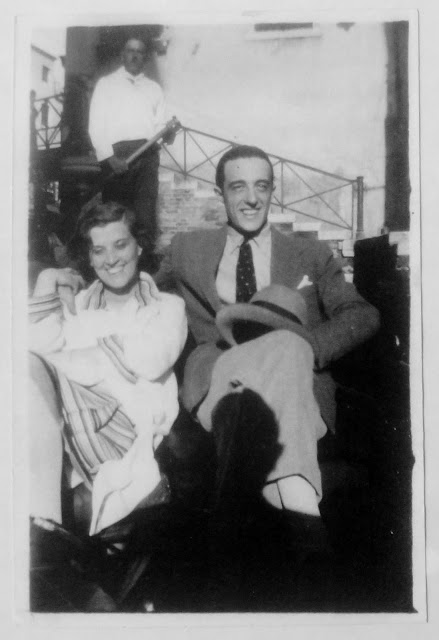
My grandparents, Giuditta Rissone and Vittorio De Sica
Nonna and Nonno in Venice
Despite her separation from my grandfather (divorce didn't exist in Italy at the time), the hardships of WWII Italy, and being a single mother in the 1950s, Nonna managed to keep it together, and star in 25 films between 1933 and 1966. One of the last roles she played was in 1962, as Marcello Matroianni's mother in the Fellini masterpiece 8 1/2.

As I said, like many nonnas, mine was a key figure during my childhood, she was there for me while my mom was working full time, adjusting to divorced life, and mourning my grandfather's premature death. Nonna Titta was great company, a playful, unconventional, tender and witty companion. She and I produced wonderful role games, during which I'd introduce her to my latest child (I owned many dolls at the time) and we'd chat and gossip like ladies over teacups of sugared tap water. Nonna spoiled me like only grandparents can (and are allowed to). And she taught me to appreciate good food through her virtuoso cooking skills.
Nonna Titta and I, ca. 1970
Me and Nonna, 1970
My son didn't get a chance to meet his great-grandparents, one of my biggest regrets. It's important that he learn about his extended family, here in Italy and the one abroad. I can start by introducing him to his great-grandmother Titta, by telling him her wonderful stories, showing him photographs and paintings, reproduce her recipes and replicate those everyday gestures of love I grew with.
Handing down cooking knowledge

Halloween is a recent celebration in Italy. The related observance we do honor on the other hand is i morti: an Italian two-day festivity bridging November 1st (All Soul's Day) and November 2nd (Day of the Dead). This is not a morbid or mournful holiday, rather a celebration of life. Ossa dei Morti, or "Bones of the Dead," are among the numerous traditional (and almost always almond-laced) Italian cookies commonly enjoyed on this occasion. There are many different regional recipes for Ossa dei Morti, these particular hard and crunchy meringue ones are from Piemonte, where nonna Titta was originally from.


She was very superstitious, so I hope she won’t mind if I associate her to this rather disturbing, sepulchral recipe name. If you hear thunder tomorrow, it’s probably her, complaining from heaven.

Giuditta Rissone, my nonna


250 g (1 cup) flour
100 g (1 1/4 cup) hazelnuts (ideally from the Langhe region, in Piemonte), shelled and left whole
100 g (1 1/4 cup) almonds, coarsely ground (I put them in a freezer bag and pound the heck out of them)
400 g (2 1/4 cups) brown sugar
2 egg whites, beaten
Juice of 1/2 lemon
Pinch of ground cloves
Pinch of cinnamon
Butter and flour to grease and dredge the cookie sheet

In a large bowl, combine the flour, sugar, egg whites, and lemon juice. Work in the nuts and spices, and continue kneading until you have a fairly firm dough. Roll the ball of dough out with your hands forming it into a rope. Cut the rope into 2-inch sections.

Preheat oven to 180° C (360° F).

Butter your cookie sheet, dust with flour, and lay the 'bones' on it distanced form one another, and bake for about 20 minutes. Let the cookies cool to jaw-breaking hardness before serving with a glass of Moscato or Vin Santo. Amen.
Ossa dei morti cookies for November 1st
Image © savoringtimeinthekitchen.blogspot.com

Apr 3, 2010

Pastiera recipe

Pastiera is the quintessential Neapolitan Easter cake.

Legend has it that pastiera was invented in a Neapolitan convent. An unidentified novice wanted her Easter cake to be a symbol of the Resurrection, and to be redolent of the spring flowers growing in the convent’s orange grove.

So she mixed a handful of wheat grains (abundance) to some mild ricotta cheese (sustenance), added some eggs (symbol of new life), some orange-fragranced water, citron and a mix of aromatic Asian spices.

The ingredients used in making Pastiera closely, suggest a more pagan spring-welcoming Dionysian type ceremony rather than an enlightened nun’s experiment: wheat kernels, goat milk’s cheese, floral water, eggs, spices and candied fruit? I say definitely mundane.

Pastiera recipe


Be that as it may, Pastiera is commonly consumed during Italian Easter festivities, an intensely religious moment of the calendar.

The name "pastiera" appears to come from the consolidated habit of using cooked pasta instead of buckwheat; there are still some who make pastiera using spaghetti and angel hair.

There are two different ways of preparing Pastiera: in an older method, the ricotta was mixed with the eggs; in the newer version, a thick pastry cream mixture is added, resulting in a softer amalgam. This recipe innovation was introduced by Signor Giovanni Scaturchio, a Neapolitan genius confectioner whose little shop of miracles still occupies a corner in Piazza San Domenico Maggiore.
Pastiera recipe

A deli in Rome sells these mini 3.5 oz pastierine from Napoli's Scaturchio, and when I got one as a present the other day I squealed with delight. They are the best.
Pastiera recipe

Here's the orignal recipe, handed down by a 100% true Neapolitan. Complex and time consuming, but oh, so worth it.

Ingredients for the shortbread/shortcrust pastry shell:

3 yolks
500 g (2 1/2 cups) all purpose flour
200 g (1 cup) sugar
200 g (1 cup) lard (cough) or butter

Ingredients for the filling:

700 g (3 1/2 cups) sheep's milk ricotta
400 g (2 cups) cooked buckwheat (can be substituted with pearl barley soaked overnight and boiled for 30 minutes; or round rice boiled for 20 minutes)
400 g (2 cups) sugar
1 lemon
1 heaped tbsp. candied citron fruit, cubed
1 heaped tbsp. candied orange, cubed
1 heaped tbsp. candied pumpkin (locally called "cucuzzata") last 3 items can be substituted by assorted candied fruits
100 ml (1/2 cup) milk
30 g (1 oz) butter
5 eggs + 2 yolks
1/2 tsp. vanilla extract
1 tbsp. orange blossom water (if you can't find it, use the zest of 1 orange)
A pinch of powdered cinnamon

If you were unable to find cooked and canned buckwheat, you'll have to cook the raw kind, or substitute it with the other grains and cooking procedures mentioned above.

Soak the raw buckwheat in water. Drain and rinse well under running water before cooking in plenty cold unsalted water. When the water boils, reduce the heat and cook at a gentle simmer for 90 minutes undisturbed (no stirring).

In the meantime, if you decide not to use prepackaged and frozen pastry dough, combine flour sugar and softened butter in a mixing bowl. Drop in the yolks one at a time, and work into an even dough. Otherwise thaw the frozen pastry.

When the ingredients are well mixed, work the dough by quickly folding it over a few times. Beware: the more you work shortbread the less it will be soft and supple!

Let the dough rest 30 minutes, covered by a damp kitchen towel.

Mix the cooked buckwheat, milk, butter and the zest of 1 lemon in a saucepan, and cook over medium heat for 10 minutes. Stir often, and cook until the mixture is quite creamy.

Whip the ricotta in the blender with the eggs and yolks, the sugar, vanillin, floral water and cinnamon. Once this is well blended and fluffy, fold in the candied fruits and cooked buckwheat mix, and stir until fully blended.

If you are using the frozen shortcrust pastry dough, once it is thawed soft, unroll it. Now whether packaged or homemade, the dough needs to be flattened. Use a rolling pin and work the dough to 1/4 of an inch in thickness. Line a 9-inch buttered pie shell with the pastry. With the excess dough cuttings, you can make some lattice strips for decoration.

Pour the filling mixture in the prepared pie shell, fold the brim inwards and decorate the top part with the strips of extra dough. Brush the criss cross lattice with egg yolk or melted butter mixed with sugar if you like. This will make it shine.

Bake in the oven at 180° C (350° F) for 90 minutes, or until amber in color.

Let the cake cool completely and dust it with icing sugar before serving.

It's hard work, I know.
Pastiera is best cooked a few days in advance, in order to allow the fragrances to mix properly and result in that unique flavor, but I never manage to resist more than a few hours.

A mouthful of pastiera, followed by a sip of dry red wine is known to bring springtime in your mouth, la Primavera in bocca.

Pastiera recipe

Buona Pasqua!

Jan 5, 2010

Befana in Italy

Tonight, while everyone is asleep, La Befana will be coming to our house and filling my son's stocking with little gifts and candy. He will find it tomorrow morning, like many other children in Italy. We will leave out a small glass of red wine and some soft breadcrumb for her to snack on (the Befana likes her vino, but her bad teeth can only tolerate softer foods). She is not scary–although her features are less than pretty–and kids love her. Unfortunately younger generations are starting to forget how important she really is.

The befana is not a witch, as she is often recently portrayed. She's an ugly, hunched-over old woman in a raggedy scarf that sometimes flies on a broomstick (or rides a donkey) and brings happiness to children. Before Santa dethroned her, overtaking the global commercialization of Christmas, in many parts of Italy it was only la Befana who brought gifts to children on the Twelfth Night, marking the end of the holiday season. December 25th was solemnly celebrated as the birth of Jesus, a big family reunion, and involved eating lots of good food–period. No gifts.

The name Befana is the corruption of the word epifania, Italian for 'Epiphany.' That's when, on January 6th, Christians commemorate the visitation of the Magi to the Baby Jesus.

The Befana is a pagan figure belonging to Roman folklore, but according to a more religious version, her story is linked to the Three Wise Men from the Orient.

On their way to Bethlehem to bring Baby Jesus their precious gifts of gold, frankincense and myrrh, Balthazar, Melchior and Caspar got lost on the way (winter clouds momentarily shrouding the comet?).

They happened upon an old woman standing in her cozy doorway, and asked her for directions. Despite the Magi's insistence she follow them to visit the Child, the woman peremptorily refused to accompany them. Later, feeling guilty for her harsh dismissal, the old woman prepared a jute sack filled with sweets and gifts for the Babe and set out to catch up to the Three Kings, unsuccessfully.

She stopped at every home on the way, dispensing her delicious bounty to the children she'd meet, in the hope that one of them was the newborn Jesus.

From that day, every year on the night before January 6th, she is said to roam the world, giving gifts to children, in exchange for forgiveness.


La Befana proverbially loads stockings with method: a fresh tangerine at the toe, and then pieces of unwrapped bubble gum, assorted candies, gianduiotti, lollipops, chocolate coins for prosperity, a few symbolic small toys and trinkets–like stickers or crayons–and whatever she feels is right for the child in question.

Those who haven't been good find their stocking filled only with coal, but that rarely happens! Just to keep the tradition alive, every stocking must contain at least one chunk of crumbly black sugar, shaped like a lump of coal.


One larger gift is displayed near the stocking, unwrapped and ready to be played with.

I've spoken to the Befana, and she tells me this year my son will be getting a brand new bicycle with training wheels!


Buona Befana!


Jan 1, 2010

A prayer for 2010

The new year begins.

I am borrowing the poem/prayer below and offering it to you as a sign of gratitude. As a gesture of love. As a symbol of where I am right now. My new year's resolution is to repeat this prayer and reap its deep beneficial effects. I hope you will too.

This is a perfect moment. It’s a perfect moment because I have been inspired to say a gigantic prayer. I’ve been roused to unleash a divinely greedy, apocalyptically healing prayer for each and every one of us—even those of us who ­don’t believe in the power of prayer.

And so I am starting to pray right now to the God of Gods, the God beyond all Gods... the Girlfriend of God... the Teacher of God... the Goddess who invented God.


DEAR GODDESS, you who always answer our very best questions, even if we ignore you:

Please be here with us right now. Come inside us with your sly slippery slaphappy mojo. Invade us with your silky succulent salty sweet haha.

Hear with our ears, Goddess. Breathe with our lungs. See through our eyes.


DEAR GODDESS, you who never kill but only change:

I pray that my exuberant, suave, and accidental words will move you to shower ferocious blessings down on everyone who reads or hears this benediction.

I pray that you will give us what we ­don’t even know we need—not just the boons we think we want, but everything we’ve always been afraid to even imagine or ask for.


DEAR GODDESS, you wealthy anarchist burning heaven to the ground:

Many of us don’t even know who we really are.

We’ve forgotten that our souls live forever.

We’re blind to the fact that every little move we make sends ripples through eternity. Some of us are even ignorant of how extravagant, relentless, and practical your love for us is.

Please wake us up to the shocking truths. Use your brash magic to help us see that we are completely different from we’ve been led to believe, and more exciting than we can possibly imagine.

Guide us to realize that we are all unwitting messiahs who are much too big and ancient to fit inside our personalities.


DEAR GODDESS, you sly universal virus with no fucking opinion:

Help us to be disciplined enough to go crazy in the name of creation, not destruction.

Teach us to know the distinction between oppressive self-­control and liberating self-control.

Awaken in us the power to do the half-­right thing when it is impossible to do the totally right thing.

And arouse the Wild Woman within us—even if we are men.


DEAR GODDESS, you who give us so much love and pain mixed together that our morality is always on the verge of collapsing:

I beg you to cast a boisterous love spell that will nullify all the dumb ideas, bad decisions, and nasty conditioning that have ever cursed all of us wise and sexy virtuosos.

Remove, banish, annihilate, and laugh into oblivion any jinx that has clung to us, no matter how long we have suffered from it, and even if we have become accustomed or addicted to its ugly companionship.

Conjure an aura of protection around us so that we will receive an early warning if we are ever about to act in such a way as to bring another hex or plague into our lives in the future.


DEAR GODDESS, you psychedelic mushroom cloud at the center of all our brains:

I pray that you will inspire us to kick our own asses with abandon and regularity.

Give us bigger, better, more original sins and wilder, wetter, more interesting problems.

Help us learn the difference between stupid suffering and smart suffering.

Provoke us to throw away or give away everything we own that encourages us to believe we’re better than anyone else.

Brainwash us with your compassion so that we never love our own freedom more than anyone else’s freedom.

And make it illegal, immoral, irrelevant, unpatriotic, and totally tasteless for us to be in love with anyone or anything that’s no good for us.


DEAR GODDESS, you riotously tender, hauntingly reassuring, orgiastically sacred feeling that is even now running through all of our soft, warm animal bodies:

I pray that you provide us with a license to bend and even break all rules, laws, and traditions that hinder us from loving the world the way you do.

Show us how to purge the wishy-­washy wishes that distract us from our daring, dramatic, divine desires.

And teach us that we can have anything we want if we will only ask for it in an unselfish way.

DEAR GODDESS, you who just pretend to be crazy so you can get away with doing what's right:

Help us to be like you—wildly disciplined, voraciously curious, exuberantly elegant, shockingly friendly, fanatically balanced, blasphemously reverent, mysteriously truthful, teasingly healing, lyrically logical, and blissfully rowdy.


And now dear God of Gods, God beyond all Gods, Girlfriend of God, Teacher of God, Goddess who invented God, I bring this prayer to a close, trusting that in these pregnant moments you have begun to change all of us in the exact way we needed to change in order to become the gorgeous geniuses we were born to be.


Amen


Om


Hallelujah


Shalom


Namaste


More power to you


Oh, but one more thing DEAR GODDESS, you pregnant slut who scorns all mediocre longing:

Please give us donkey clown piñatas full of chirping crickets,

ceramic spice jars containing 10 million-­year-old salt from the Himalayas,

gargoyle statues guaranteed to scare away the demons,

lucid dreams while we’re wide awake,

enough organic soup and ice cream to feed all the refugees,

emerald parachutes and purple velvet gloves and ladders made of melted-down guns,

a knack for avoiding other people’s personal hells,

radio-controlled, helium-filled flying rubber sharks to play with,

magic red slippers to contribute to the hopeless,

bathtubs full of holy water to wash away our greed,

secret admirers who are not psychotic stalkers,

mousse cakes baked in the shapes of giant question marks,

stories about lightning strikes that burn down towers where megalomaniacal kings live,

solar-powered sex toys that work even in the dark,

knowledge of secret underground rivers,

mirrors that the Dalai Lama has gazed into,

and red wagons carrying the treats we were deprived of in childhood.


~Rob Brezsny


Happy 2010!


Share!