Showing posts with label nonna. Show all posts

Feb 7, 2017

Madeleine moment

Children pottering in the kitchen is not uncommon in Italy.

The vibrant core of every Italian household is the stovetop. Both 18th century peasant hearth and sleek modern design cooking areas are where Italian families gather, share, truly talk and where relationships are made. These relationships are cultivated early on, and leave deep, important memories on young children.

My earliest recollection of food-making is tied to my Nonna, my maternal grandmother Giuditta Rissone. Titta, as everyone in the family called her, was not the average nana...

Feb 14, 2012

Bagna càuda recipe

In the earliest part of my childhood I spent a lot of time with my Nonna Titta. I've spoken about her in many occasions on this blog. She was a pillar of my upbringing, and even though I was 9 when she passed away, she left me many memories and an impressive mark on my nature and individuality. I see a lot of her in myself today.

Bagna Càus, aka bagna caoda

In particular, the memories I associate the most with Nonna are sensory. The taste of her gummy, black Allenbury candies stashed in a tin box at the bottom of her beauty case, the glint in her emerald green eyes while we played pretending to be ladies having tea, and mostly, the smells coming from the kitchen when she'd cook. Her pièce de résistance was bagna càuda, characteristic of her Piedmontese origins.

This appetizer/soup, whose name in dialect means "hot bath," is enjoyed by dipping raw, boiled or roasted vegetables in a manner similar to fondue in a heated blend of garlic, anchovy and olive oil. It is traditionally an autumn/winter recipe and must be eaten hot, as the name suggests.
My Nonna's bagna càuda terracotta pan

Bagna Càuda can be served in individual dipping bowls, or placed in a larger terracotta pan, placed on a burner at the center of the table, for communal sharing. Pictured above is the clay pot in which Nonna cooked and served hers.

Whenever my mother or I make Bagna Càuda, this is what we we still use.

Here's how we continue Nonna's tradition:
500 g (2 1/2 cups) extra virgin olive oil
150 g (3/4 cup) salted anchovies
50 g (1/4 cup) butter
6 cloves of garlic, peeled

Assorted vegetables for dipping:
2 cardoons (if these are not available where you live, substitute with 3–4 ribs of white celery, cut in sticks)
2 yellow bell peppers, cut in sticks
1 cup cauliflower florets
2 topinambur (aka Jerusalem artichoke, sunroot, sunchoke, or earth apple), peeled and cut in chunks
5 radishes, peeled
2 carrots, cut in sticks
2 artichokes, cored, outer leaves removed and quartered lengthwise
3 spring onions
My Nonna's bagna càuda terracotta pan

Scrape the anchovies with a paring knife, rid them of the bones and open them flat. Brush away excess salt with a kitchen towel, and do not rinse with water.

Thinly slice the garlic and trim away green parts, if any.

In an enameled terracotta pan (if you don't have one, a common nonstick saucepan will do), melt the butter over extremely mild heat, add the garlic and let it tan without browning.

Add the olive oil and the anchovies, gently simmering, stirring and breaking up the fillets with the back of a wooden spoon. Do this for 10 minutes, or until the sauce is creamy and evenly blended.

Serve on a fondue burner or on a cooling rack placed over tea light candles to keep the delicious bagna as càuda as possible while you gobble away, washing down with rivers of Barbera or Dolcetto.

Note: For those fearsome of such copious amounts of garlic, there's a trick: you halve the quantity of oil and compensate with a cup of whole milk, to be poured in at the same time. Identical garlic quantity, and same exact procedure: the milk tames the punch of the garlic.

It works, trust Nonna.
My Nonna's bagna càuda terracotta pan

Dec 3, 2011

Carpaccio recipe from Harry's Bar, Venice

Carpaccio was for a long time the most popular dish served at Harry’s Bar in Venice. It is named after Vittore Carpaccio, the Venetian Renaissance painter known for his use of brilliant reds and whites in the minute detail of his infinite perspective landscapes.

Giuseppe Cipriani, the Bar's historic owner, invented and named the dish in reference to the Venetian painter, because the colors of the dish reminded him of his paintings. It was 1950, the year of the great Carpaccio exhibition in Venice.
Vittore Carpaccio

The Harry's Bar Carpaccio dish was inspired by capricious Contessa Amalia Nani Mocenigo, a local regular at Harry's Bar. Her doctor had put her on a strict diet recommending she eat only raw meat.

The original Harry's Bar delicacy is still made by covering a plate with the thinnest possible slices of raw beef and garnishing them with a secret dressing that is drizzled over the beef in a crosshatch, Kandisnsky-style pattern. It is proverbially called the "universal sauce."
Harry's Bar in Venice

I was raised on a strict Harry's Bar diet of Carpaccio and Risotto Primavera, myself. Those were the days when going to Venice for the weekend was a given, and money wasn't an issue. The source of our family's financial ease was the talented work and infinite generosity of my grandfather Vittorio De Sica.
Family portrait on my 2nd birthday

My fondest memories of him are not glamourous, nor show business-related, they are personal. The vivid images and toasted coffee aroma of our Sunday afternoons spent together still linger in my mind when I think of him. Nonno would nap after having lunch with us, wrapped in a brown cashmere plaid throw, lying on the day bed in what later became my bedroom. I'd be the one to wake him, softly tiptoeing in the dimly lit room, carrying a tray with a small demitasse of espresso, which he'd sip quietly. 

The bottom of the cup was my prize, a tiny ring of coffee-tinted sugar that had not quite melted. I'd draw the drapes open and we'd play for a half hour, during which I would frequently show him my latest dance coreographies. My clumsy pirouettes, that would usually land me on my rear end, would obviously make him chuckle, but he never showed it, giving my performance the professional judgement of an unbiased director. Nonno would often tell me where to improve or applaud the less disastrous ones. Then he'd leave, cloaked in his grey flannel suit, elegant and smelling of blue Pantène hair cologne and weathered leather, like his gloves. A wink and a smile on the doorstep and he was gone, 'til the following week.

My grandfather's successful career ended too soon. Cinema lost one of its greatest modern film making artists in 1974 to lung cancer, and my playful Sunday afternoons with Nonno were no more.
Mom, me and Nonna in Venice
with mom and Nonna Titta on the Grand Canal
I don't care if I don't go to Venice for the weekend any more. I've never been a fool for fancy clothes or elegant hotels. I love to travel and eat, and I still do that, on a shoestring. And since I could charm my way through a restaurant kitchen from age five, I managed to snatch the secret Carpaccio recipe. For free.

1.3 kg (3 lb) beef sirloin, whole
3/4 cup homemade mayonnaise
1–2 tsp Worcestershire sauce, adjust quantity to taste
1 tsp fresh lemon juice
2–3 tbsp whole milk
Salt and freshly ground white pepper

First of all, make the carpaccio "universal sauce," which is the focal point of this dish. The above-mentioned quantities yield about 250 ml (1 cup). Any leftover can last about 3 days, stored chilled in a closed container.

Put the mayonnaise in a bowl and add the Worcestershire sauce and lemon juice, and blend with a whisk.

Add enough milk to thin the sauce, so it just barely coats the back of a dry wooden spoon. Taste and adjust seasoning, with more Worcestershire sauce and/or lemon juice if necessary.

OK, now the tricky part.

According to tradition, the best carpaccio is made with beef sirloin, and the flavorful meat must never be frozen before slicing. Of course it's easier to slice barely thawed beef, but we're not taking any shortcuts today.

Carpaccio can also be made with beef tenderloin filet, which has a milder flavor than sirloin and is much easier to handle. Ask the butcher to trim the meat for you. You may even be able to convince him to slice it, but do so only if you plan to serve your carpaccio an hour or 2 later, tops.

If you decide to slice the meat yourself, please be careful, I nearly lost a fingertip once.

Trim every bit of fat, gristle, sinew from the sirloin, leaving a small cylinder of tender, lean meat.

Chill the meat for 30 minutes, then using a long-bladed razor-sharp knife, slice the meat paper-thin and arrange the slices on individual salad plates, covering the surface completely. Makes about six servings. Some folks like to sprinkle some shaved Parmigiano at this point. I don't, preferring to maintain the flavors and simplicity intact.

Drizzle the universal sauce decoratively over the meat, and serve immediately.

Harry's Bar Carpaccio with Universal Sauce

I quite like this with a properly stored Valpolicella: light in body, low in tannin, and redolent of tart red cherries.

Buon appetito.

Nov 1, 2010

Ossa dei morti recipe

My Nonna Titta raised me like a mother; like all grandmothers do in Italy–even before it was customary for working moms to leave home to bring income to the household.

Yet Giuditta–Titta for her friends and immediate family–was not your average granny. She told fairy tales, baked cakes and occasionally knitted; but in her youth she had been a talented, successful and beautiful theater actress. And with a childhood worthy of a novel.
Giuditta Rissone, my nonna

Born into a theater family, she began touring around the world with the Ermete Zacconi theater company along with her parents and brothers from when she was old enough to stand (as a small child she was forced to play only boys' roles, a female child in theater was not happy news). The kids (four boys and one girl, Titta) were the younger thespians acting opposite turn of the century celebrities, while my great-grandfather was the "trovarobe," in charge of painting backdrops, collecting furniture, set dressing, props, etc. Nowadays this role is called Production Designer. His wife, my bisnonna Luigia, was a seamstress. She designed all the costumes for each production, and was in charge of cutting, stitching and fitting all.

This wild assortment of talent traveled away from Italy each summer, headed to South America, where the company performed mostly for immigrant patrons in theaters all over Paraguay, Uruguay, Argentina and Chile. Italians didn't only land in Ellis Island…

My nonna Titta didn't speak a word of English, but thanks to these annual 6-month tours, she was fluent in Spanish and grasped the rudiments of Portuguese.

Once the season ended abroad, the company would pack the staging equipment and navigate the Atlantic on steamships back to Europe, just in time for winter in the northern hemisphere. Titta loved the summer, because for so many years of touring, she said, summer was not an option.

Later, as she grew into a teen and then into a young woman, her talent and sophisticated flair put her in the limelight. She soon became leading lady in many popular 1920s stage productions, and her repertoire spanned from the Greek classics, Shakespearean drama, to humorous, intelligent and ironic contemporary pieces. In 1930 she met my grandfather, whom she formed a company with, and eventually married seven years later. My mom was born the following year, and this gave Titta the chance to finally retire from the theater scene at age 42.
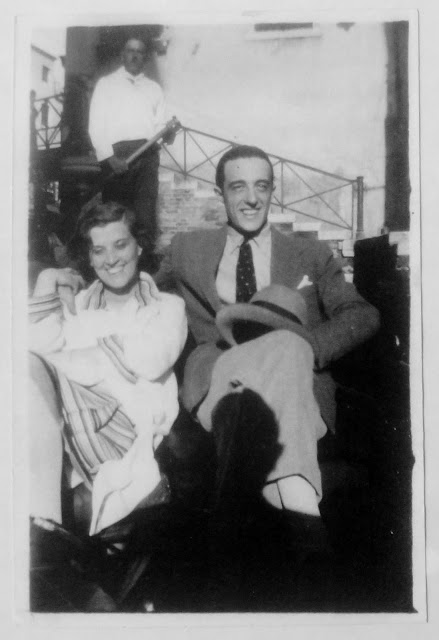
My grandparents, Giuditta Rissone and Vittorio De Sica
Nonna and Nonno in Venice
Despite her separation from my grandfather (divorce didn't exist in Italy at the time), the hardships of WWII Italy, and being a single mother in the 1950s, Nonna managed to keep it together, and star in 25 films between 1933 and 1966. One of the last roles she played was in 1962, as Marcello Matroianni's mother in the Fellini masterpiece 8 1/2.

As I said, like many nonnas, mine was a key figure during my childhood, she was there for me while my mom was working full time, adjusting to divorced life, and mourning my grandfather's premature death. Nonna Titta was great company, a playful, unconventional, tender and witty companion. She and I produced wonderful role games, during which I'd introduce her to my latest child (I owned many dolls at the time) and we'd chat and gossip like ladies over teacups of sugared tap water. Nonna spoiled me like only grandparents can (and are allowed to). And she taught me to appreciate good food through her virtuoso cooking skills.
Nonna Titta and I, ca. 1970
Me and Nonna, 1970
My son didn't get a chance to meet his great-grandparents, one of my biggest regrets. It's important that he learn about his extended family, here in Italy and the one abroad. I can start by introducing him to his great-grandmother Titta, by telling him her wonderful stories, showing him photographs and paintings, reproduce her recipes and replicate those everyday gestures of love I grew with.
Handing down cooking knowledge

Halloween is a recent celebration in Italy. The related observance we do honor on the other hand is i morti: an Italian two-day festivity bridging November 1st (All Soul's Day) and November 2nd (Day of the Dead). This is not a morbid or mournful holiday, rather a celebration of life. Ossa dei Morti, or "Bones of the Dead," are among the numerous traditional (and almost always almond-laced) Italian cookies commonly enjoyed on this occasion. There are many different regional recipes for Ossa dei Morti, these particular hard and crunchy meringue ones are from Piemonte, where nonna Titta was originally from.


She was very superstitious, so I hope she won’t mind if I associate her to this rather disturbing, sepulchral recipe name. If you hear thunder tomorrow, it’s probably her, complaining from heaven.

Giuditta Rissone, my nonna


250 g (1 cup) flour
100 g (1 1/4 cup) hazelnuts (ideally from the Langhe region, in Piemonte), shelled and left whole
100 g (1 1/4 cup) almonds, coarsely ground (I put them in a freezer bag and pound the heck out of them)
400 g (2 1/4 cups) brown sugar
2 egg whites, beaten
Juice of 1/2 lemon
Pinch of ground cloves
Pinch of cinnamon
Butter and flour to grease and dredge the cookie sheet

In a large bowl, combine the flour, sugar, egg whites, and lemon juice. Work in the nuts and spices, and continue kneading until you have a fairly firm dough. Roll the ball of dough out with your hands forming it into a rope. Cut the rope into 2-inch sections.

Preheat oven to 180° C (360° F).

Butter your cookie sheet, dust with flour, and lay the 'bones' on it distanced form one another, and bake for about 20 minutes. Let the cookies cool to jaw-breaking hardness before serving with a glass of Moscato or Vin Santo. Amen.
Ossa dei morti cookies for November 1st
Image © savoringtimeinthekitchen.blogspot.com

Share!